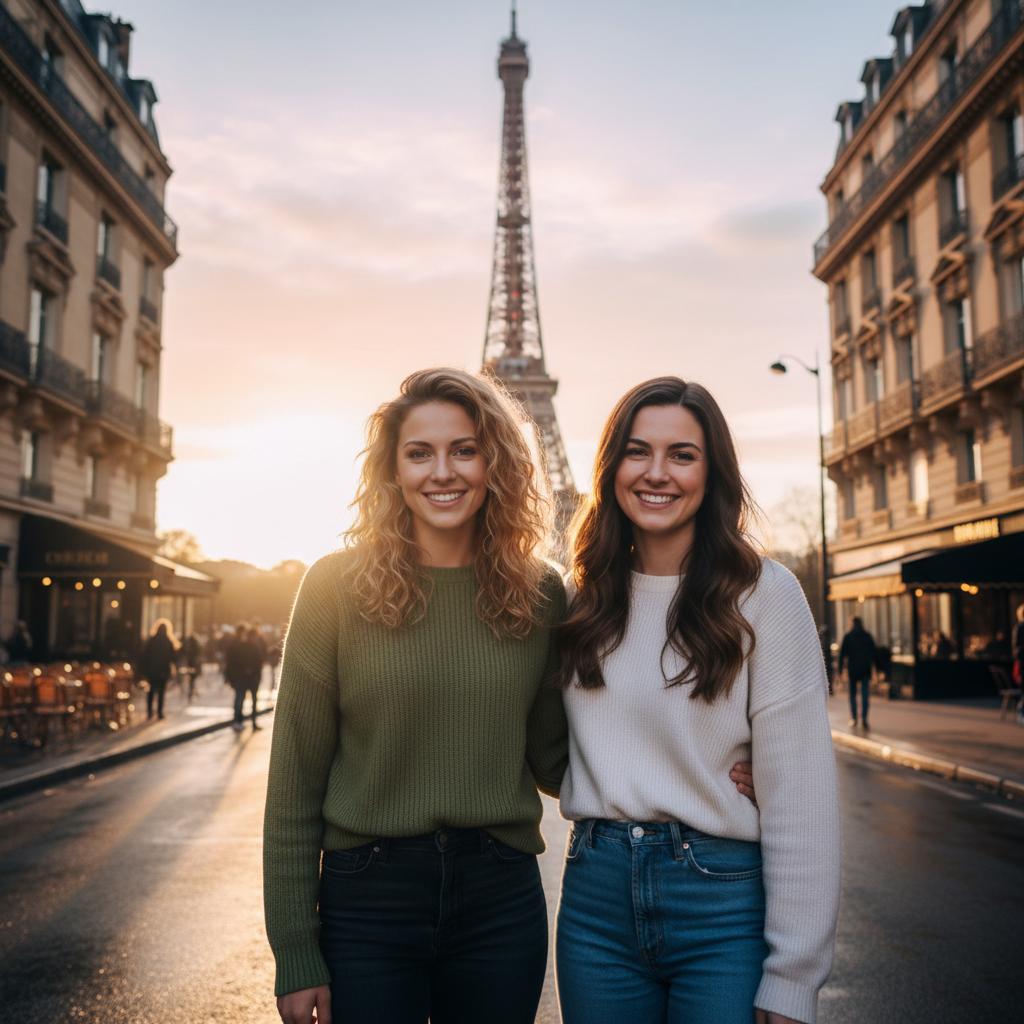
A practical guide for “couple photo poses”
Almost every stiff couple photo fails for the same reason: both people are standing straight, facing the camera, with nothing to do with their hands. Change one of those three things and the pose fixes itself, which is why most of the ideas below are really instructions about hands and direction.
Decide who leads and who reacts. A pose reads as natural when one of you does something and the other responds, so agree in advance that one person moves and the other follows rather than both waiting for the shutter.
Give the camera a job too. Shooting from slightly below eye level makes people look taller and more relaxed, and shooting from the side rather than head on stops a pose from flattening into a line-up.
If you live in different cities and cannot stand in the same frame, the pose still matters. TogetherLens composes one picture from a clear portrait of each of you, so pick a shared pose and match the light between the two portraits.
Three scenes that fit this idea
Forehead touch
Stand close, tilt the heads until they meet and look down rather than at the camera. Put one hand on the other person's shoulder so the arms do not hang.
One behind the other
The person behind wraps both arms around the waist, the person in front holds those hands. This hides both sets of arms and reads as close without being posed.
Walking hand in hand
Shoot mid stride from the side, not from the front. Let the arms swing naturally rather than locking elbows.
Sitting on steps
One step apart, knees turned slightly inward, feet on different steps. Sitting removes the standing stiffness completely.
Dancing in the street
One hand held, one arm out, both looking at each other. Ask for one frame mid-turn, because the movement is the pose.
Laughing mid-sentence
Say something ridiculous and shoot during the reaction. Give it three frames, since the second and third are usually the honest ones.
Piggyback
Camera slightly below, shoot from the side. Keep the carrier facing forward so the position stays stable.
Looking at the same thing
Both of you look out of frame at something, so nobody faces the camera. This is the fastest way to look unposed.
Hands only, close up
Two hands, one held ring, a plain background. Useful when the faces are tired or the light is gone.
Under an umbrella in the rain
A clear umbrella keeps faces lit, and the wet street doubles the light. Stand close enough that the umbrella covers both of you.
Back hug, camera behind
Shoot from behind with both faces turned back over the shoulder. Turn the nearer shoulder slightly down so neither chin disappears.
Overhead lying on grass
Lying head to head, camera directly above. Anything else in the frame such as a jacket or a coffee cup fills the empty corners.
Choose source photos the model can read
TogetherLens creates a new composition from the people you provide. It does not need matching backgrounds, but it does need clear facial information. Start with the original file when possible rather than a screenshot downloaded from a social network or messaging app.
- One clear portrait per person, eyes open, no heavy filter
- Similar light on both portraits if you are composing them later
- Faces at a similar size and angle so the pair reads as one frame
- Recent photos, because an old portrait does not look like you now
- Permission from both people before anything is generated or shared
- Keep each face fully visible and ask every living person for permission.
Generate in three deliberate steps
- Add two to five people.Use one clear portrait for each person and review every crop before continuing.
- Choose one or two vibes.Pick a scene that supports the story instead of competing with the faces.
- Inspect the result.Check eyes, teeth, hands, clothing, jewelry, and meaningful background details before sharing or printing.
What to avoid
- Standing straight and facing the camera with empty hands
- Locking elbows when holding hands
- Shooting a standing pose from above, which shortens everyone
- Presenting an AI-composed couple photo as a real photograph
Generated photos are creative images, not documentary evidence. Disclose that the result is AI-generated when context matters, and never use someone’s face to impersonate, embarrass, or mislead.
Questions about this portrait
What do we do with our hands in a couple photo?
Hold each other, hold an object, or hold the frame itself such as a cup, an umbrella or a railing. The single most common reason a pose looks stiff is two pairs of empty hands.
How do we pose if one of us is much taller?
Have the taller person sit, lean or bend a knee rather than the shorter person reach upward. Forehead touch and sitting on steps both solve a height difference without anyone standing on toes.
Which couple poses look least staged?
Walking, laughing mid-sentence, looking at the same thing out of frame, and any pose where one of you is doing something and the other reacts. Poses read as staged when both people wait for the shutter.
How many poses do we need in one session?
Three or four. Change what you do rather than where you stand, and stop while the session still feels easy. Most couples run out of patience before they run out of poses.
Can we do these poses if we are not in the same city?
Yes. Choose the pose, take one clear portrait each in similar light, and TogetherLens composes one picture with both of you in it.
Is TogetherLens free?
TogetherLens is free to install on iPhone and Android. Photo generation uses paid tokens, and Premium is optional; your app store shows the price and any renewal terms before you buy.